

The U.S. Embassy in Jakarta and the U.S. Mission to ASEAN welcomed U.S. nuclear stakeholder engagement expert Dr. Kelle Barfield to Indonesia from June 22 to 24 as part of the Freedom 250: American Leadership in Energy Security initiative. The program promoted dialogue on the role of civil nuclear energy in strengthening energy security, improving air quality, and creating economic opportunities across Southeast Asia. It also reflected the United States’ commitment to supporting the region’s long-term energy transition through partnerships with Indonesia, Singapore, the Philippines, and ASEAN. The visit formed part of a broader series of engagements across the three countries.
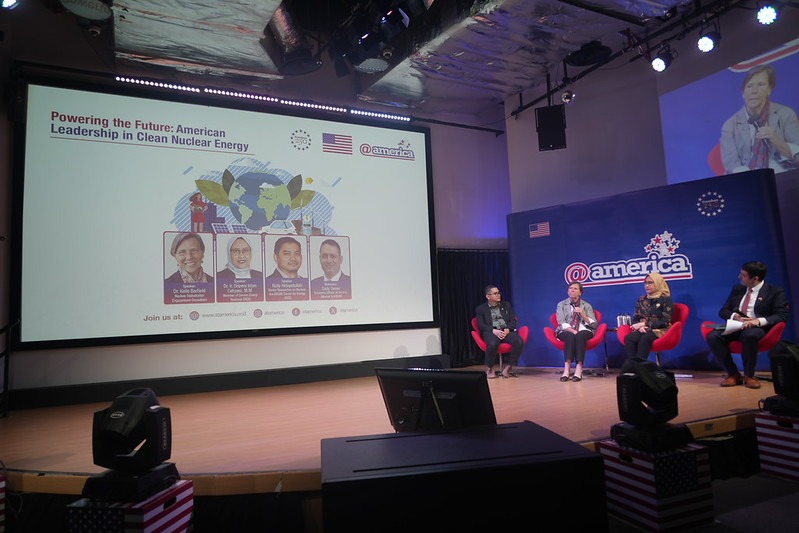
The program began in Bandung, where Dr. Barfield met with researchers from the Bandung Institute of Technology (ITB), the National Research and Innovation Agency (BRIN), and officials from the Geological Agency of Indonesia’s Ministry of Energy and Mineral Resources. In Jakarta, she led discussions with Indonesian energy companies and senior government officials on the potential of small modular reactors (SMRs) to support the country’s future energy needs. She also participated in a public panel titled Powering the Future: American Leadership in Clean Nuclear Energy at @america, alongside representatives from Indonesia’s National Energy Council and the ASEAN Centre for Energy. The event brought together more than 100 stakeholders from government, academia, industry, and regional organizations to discuss the future of civil nuclear energy.
During the discussions, Dr. Barfield emphasized that Indonesia already possesses decades of experience operating research reactors and has the expertise needed to expand its nuclear capabilities. She stressed that successful nuclear energy development depends not only on technology and cost, but also on public confidence and community support. According to her, the United States offers valuable experience in maintaining transparency and engaging local communities throughout the development of nuclear projects. She said these practices could help Indonesia build public trust as it considers advanced nuclear technologies.
On the final day of the visit, Dr. Barfield met with regional journalists and officials from the ASEAN Secretariat, the ASEAN Centre for Energy, the ASEAN Nuclear Energy Sub-sector Network, and the Economic Research Institute for ASEAN and East Asia (ERIA). Discussions focused on how ASEAN member states can safely deploy small modular reactors while meeting growing electricity demand and strengthening regional energy security. U.S. Embassy spokesperson Jamie Ravetz reaffirmed Washington’s commitment to supporting Indonesia and ASEAN with safe, transparent, and high-standard nuclear energy solutions. The program concluded by reinforcing the shared goal of expanding regional cooperation and building a more secure and sustainable energy future across the Indo-Pacific.
Alexander Jason – Redaksi
