

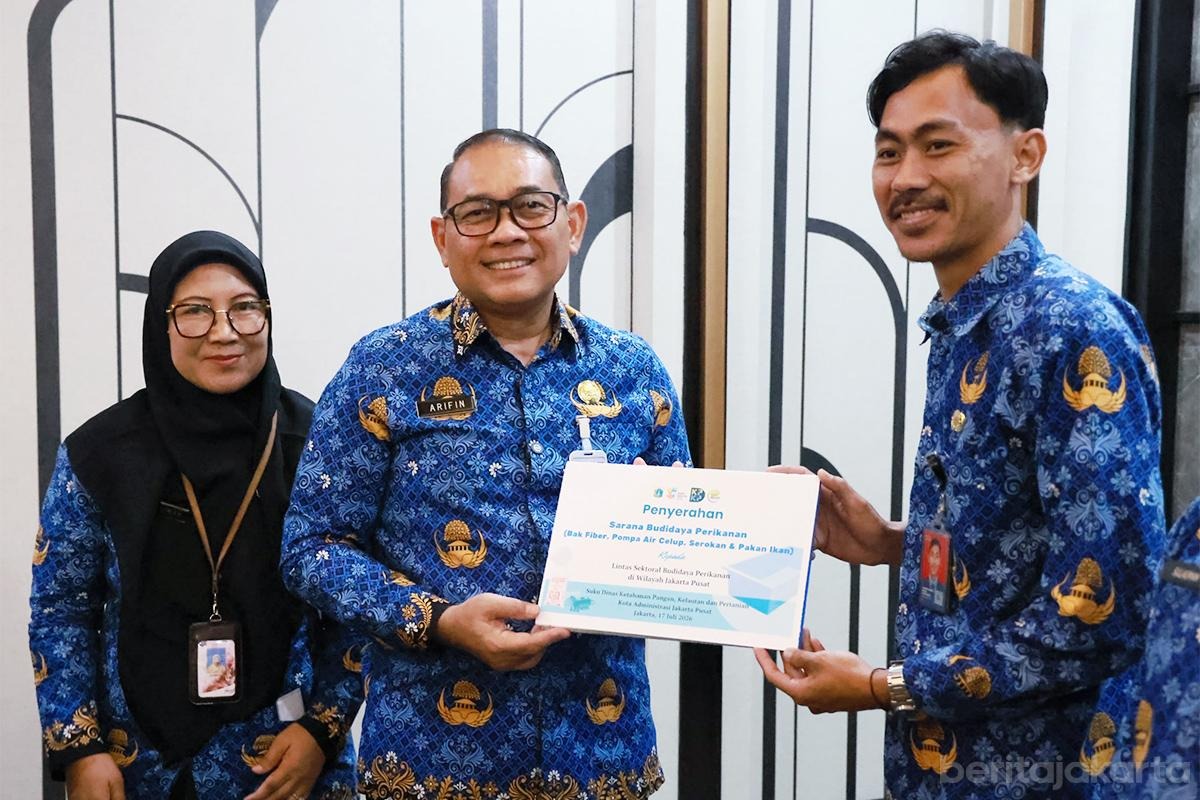
The Central Jakarta City Administration has distributed dozens of fish farming support packages to government agencies, schools, neighborhood organizations, and community institutions as part of its ongoing food security initiative. Central Jakarta Mayor, Arifin handed over the assistance to 48 recipients across the city’s eight districts, emphasizing the importance of collaboration among different sectors. The program is intended to strengthen local food resilience while encouraging sustainable aquaculture practices in urban communities. The initiative also reflects the Jakarta Provincial Government’s commitment to expanding access to nutritious food through community-based programs.
Arifin said cross-sector cooperation remains essential in building long-term food independence, particularly by promoting fish farming in government offices, schools, Child-Friendly Integrated Public Spaces (RPTRA), and neighborhood organizations. According to him, developing small-scale aquaculture can serve multiple purposes, including providing healthy food, supporting educational activities, and empowering local communities. He expressed hope that the equipment would be properly maintained and continue delivering lasting benefits to surrounding neighborhoods. The initiative demonstrates that urban food security can be strengthened through practical programs implemented at the community level.
Meanwhile, Head of the Central Jakarta Food Security, Maritime Affairs, and Agriculture Sub-agency, Siti Halimah explained that the assistance packages include fiber tanks, submersible water pumps, fish nets, fish fry, and fish feed. The recipients had previously submitted formal requests to support various activities, including the Adiwiyata environmental education program, urban village competitions, and other cross-sector initiatives. Providing complete equipment is expected to help recipients establish and sustain small-scale fish farming operations more effectively. Such support highlights the government’s effort to combine environmental education with practical food production.
The program illustrates how local governments can promote food security through partnerships with educational institutions, public agencies, and community organizations. Beyond increasing access to fresh sources of protein, urban aquaculture initiatives can also encourage environmental awareness and strengthen community participation. Expanding similar programs across more neighborhoods could help reduce dependence on external food supplies while fostering greater self-reliance. As cities continue facing population growth and food supply challenges, collaborative community-based projects like this may become an increasingly important component of sustainable urban development.
Alexander Jason – Redaksi
