

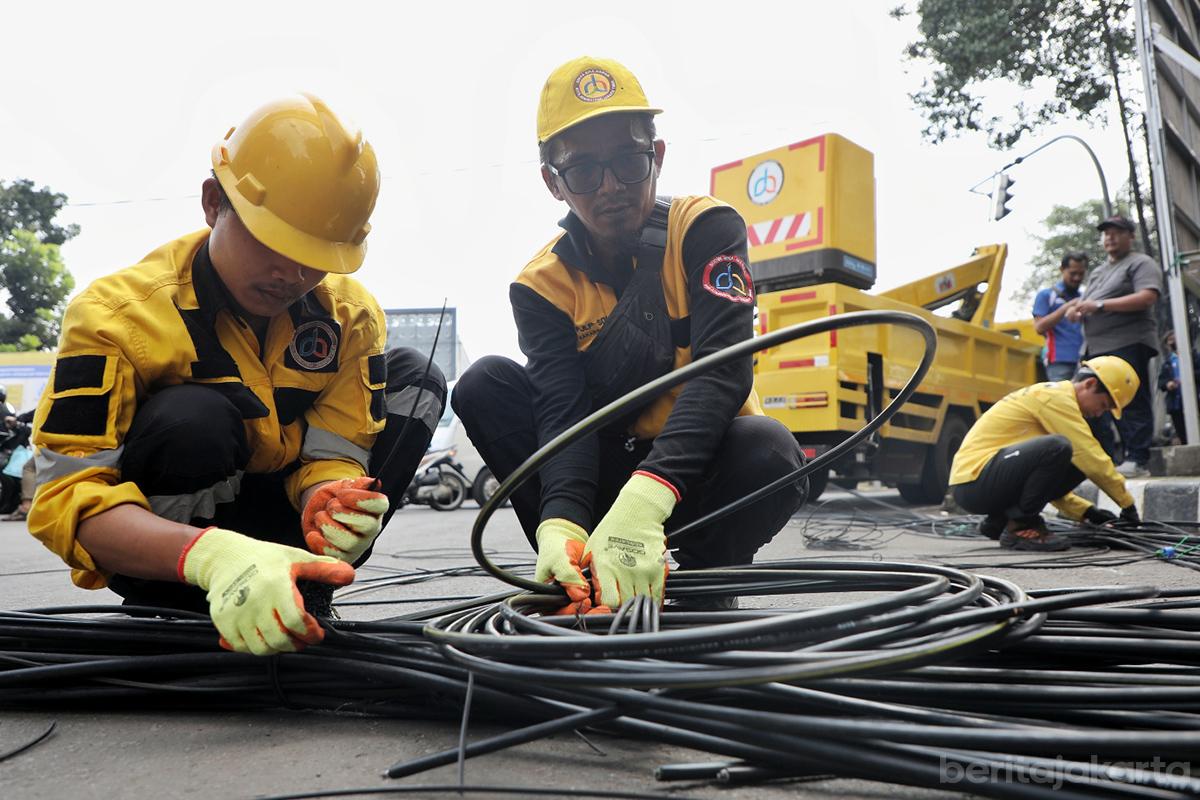
The Jakarta Regional House of Representatives (DPRD) Commission D has urged the Jakarta Provincial Government to immediately implement the Regional Regulation (Perda) on Utility Networks, arguing that its execution remains stalled due to the absence of supporting technical regulations. Chair of Commission D, Yuke Yurike, stated that although the regulation has already been enacted, its implementation has yet to progress because the required Governor Regulation (Pergub) has not been finalized. She warned that the condition of utility infrastructure in the capital has become increasingly urgent. The appeal reflects growing concerns over public safety and urban infrastructure management.
Yurike pointed to the widespread presence of disorganized overhead cables and poorly maintained utility poles across Jakarta, describing them as both an eyesore and a potential hazard. She noted that complaints about unsafe utility infrastructure continue to surface during community outreach activities and stressed that authorities should act before further accidents occur. According to Yurike, the Provincial Government must promptly complete the technical framework, including determining which operators will be responsible for managing utility networks. She added that proper implementation would improve both safety and accountability.
Beyond improving the city’s appearance, Yurike emphasized that organizing utility networks would also allow the government to establish a comprehensive database of operators using public infrastructure. A clear registry, she argued, would strengthen oversight while enabling the city to optimize Regional Original Revenue (PAD) through appropriate fees and levies. She criticized the current situation, where some operators install cables and poles without adequate responsibility or coordination. Strengthening regulatory enforcement, she said, would help ensure that all utility providers comply with established standards.
Yurike also called on the Jakarta Public Works Agency to take a more proactive role by removing abandoned cables and inspecting utility poles without waiting for public complaints or accidents. She further urged that utility network improvements be coordinated with other infrastructure projects to avoid repeated road excavations and prolonged traffic congestion. Better coordination among government agencies and utility operators, she argued, would make construction work more efficient while minimizing disruptions for residents. Such an integrated approach is expected to enhance public safety, improve the city’s appearance, and support more effective urban infrastructure management.
Alexander Jason – Redaksi
