
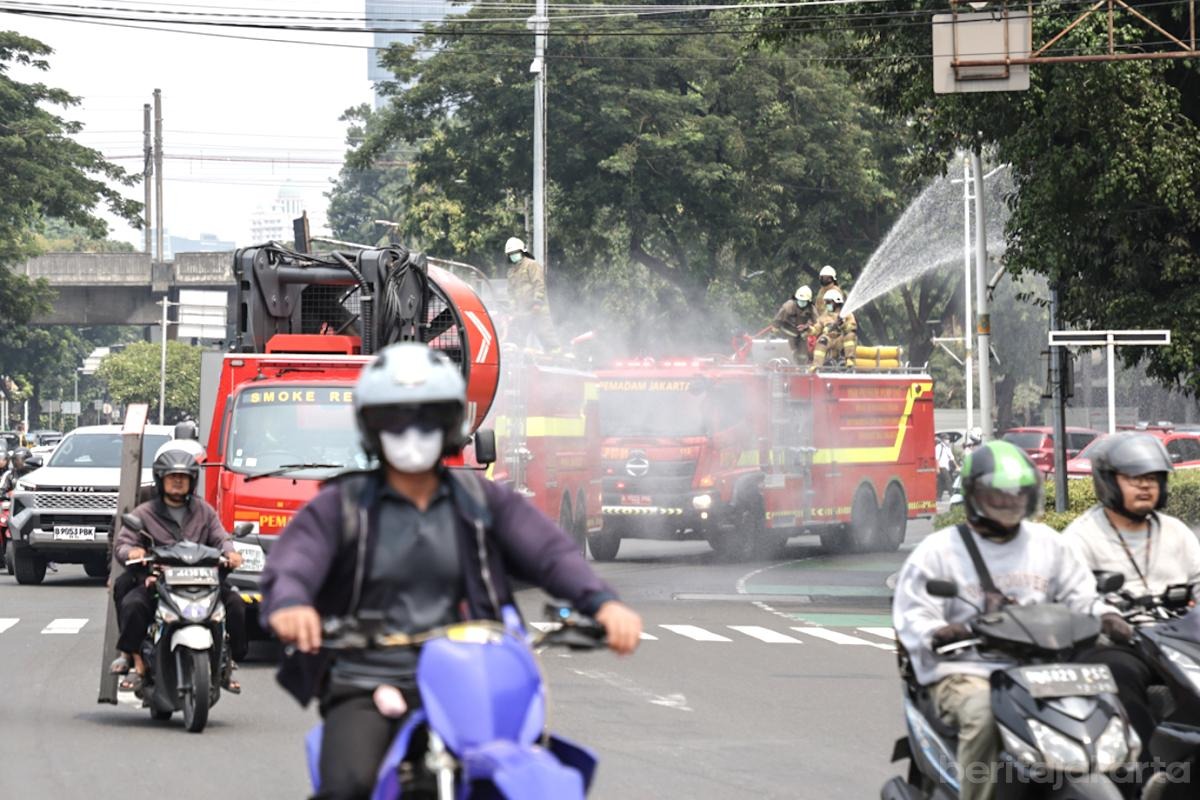
Around 150 personnel from the Jakarta Civil Service Police Unit, Regional Disaster Management Agency, Transportation Agency, Indonesian National Police, and Indonesian Military carried out another water-mist operation across several major roads in Central Jakarta on Tuesday, September 8. The operation was conducted in response to the spread of volcanic ash from the eruption of Mount Anak Krakatau. Authorities said the measure was intended to provide public services while helping protect residents from the health impacts of ash exposure. The operation reflects Jakarta’s efforts to manage the immediate effects of the volcanic activity in the capital.
The spraying involved 32 vehicles from the Fire and Rescue Agency, Regional Disaster Management Agency, and Environmental Agency. The convoy began around the National Monument area near Medan Merdeka Selatan before continuing toward Tugu Tani, MH Thamrin, and Sudirman. It then reached the Tugu Pemuda Senayan turnaround before returning to the National Monument. The route covered several of Central Jakarta’s busiest public corridors, where ash exposure could affect large numbers of residents and commuters.
Central Jakarta Government Assistant for Administration, Prasetio Kurniawan, said the operation was carried out to serve the public while maintaining public health. He urged residents not to become alarmed or overly concerned about the impact of volcanic ash from Mount Anak Krakatau. Residents were encouraged to wear masks when carrying out activities outdoors as a precaution against airborne particles. Authorities also reminded the public to rely on official Jakarta provincial government channels for accurate updates.
The emphasis on official information is particularly important as volcanic activity can generate public concern and misinformation. Jakarta authorities are combining direct mitigation measures such as water misting with health precautions for residents who must remain outdoors. The operation also demonstrates coordination among civilian agencies, emergency responders, police, and the military in addressing an environmental hazard. For residents, the immediate priority remains following official guidance, limiting unnecessary exposure, and using appropriate protection while ash conditions persist.
Alexander Jason – Redaksi
