

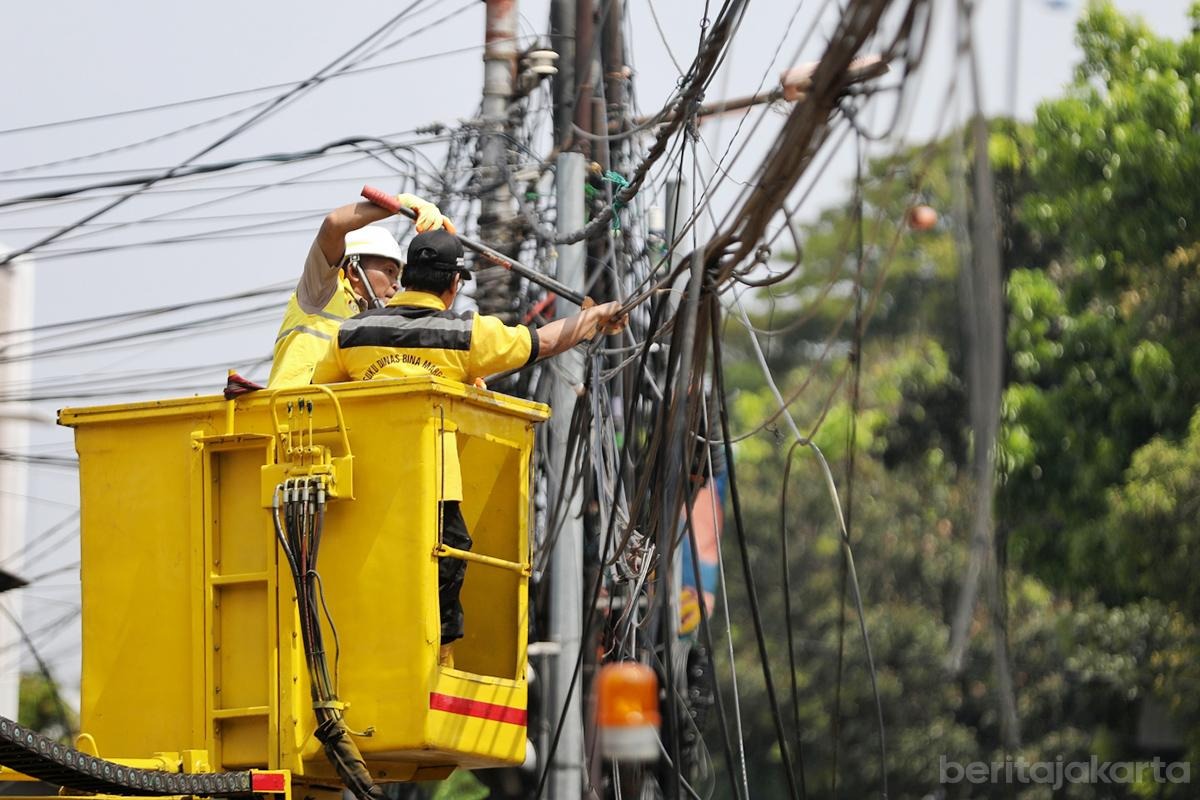
The Jakarta Provincial Government is preparing the 5M Movement to organize the city’s utility networks ahead of Jakarta’s five-century milestone. The program responds to the continued disorder of utility infrastructure, particularly overhead cables, along several roads across the capital. Head of the Jakarta Public Works Agency, Heru Suwondo, said the first M focuses on Using Integrated Utility Network Facilities, known as Sarana Jaringan Utilitas Terpadu (SJUT). Jakarta has so far built 54.2 kilometers of SJUT across 28 road sections, with 33.08 kilometers of utilities already relocated underground, 8.6 kilometers currently under relocation, and another 12.5 kilometers planned.
The second M calls for independent utility relocation on roads where SJUT facilities are not yet available. By 2026, independent relocation has been carried out along 38 road sections covering a combined 46.5 kilometers across all five administrative areas of Jakarta. The third M involves Binding Overhead Cables by organizing and securing active cables so they no longer appear tangled or hazardous. The fourth and fifth measures involve Cutting inactive overhead cables and Raising sagging cables to improve the safety of road users.
The program is being implemented with utility associations and network operators, with cable organization planned across 59.55 kilometers in Jakarta during 2026. East Jakarta accounts for the largest portion at 21.6 kilometers, followed by West Jakarta at 16.7 kilometers and North Jakarta at 8.4 kilometers. Central Jakarta is scheduled for 5.6 kilometers of work, while South Jakarta accounts for 4.2 kilometers. The work includes removing unused cables, binding and organizing active networks, and raising cables that hang too low above roads.
The 5M Movement therefore represents more than an effort to improve Jakarta’s visual appearance, as tangled utility networks can also create direct risks to public safety and urban mobility. The government has emphasized that inactive infrastructure should be removed rather than left suspended indefinitely, while functioning cables need to be properly secured. The approach also reflects the growing challenge of managing telecommunications and other utility networks in a densely developed metropolitan area. As Jakarta approaches its five-hundred-year milestone, the success of the program will depend on sustained coordination with operators and consistent enforcement of safer utility standards.
Alexander Jason – Redaksi
