

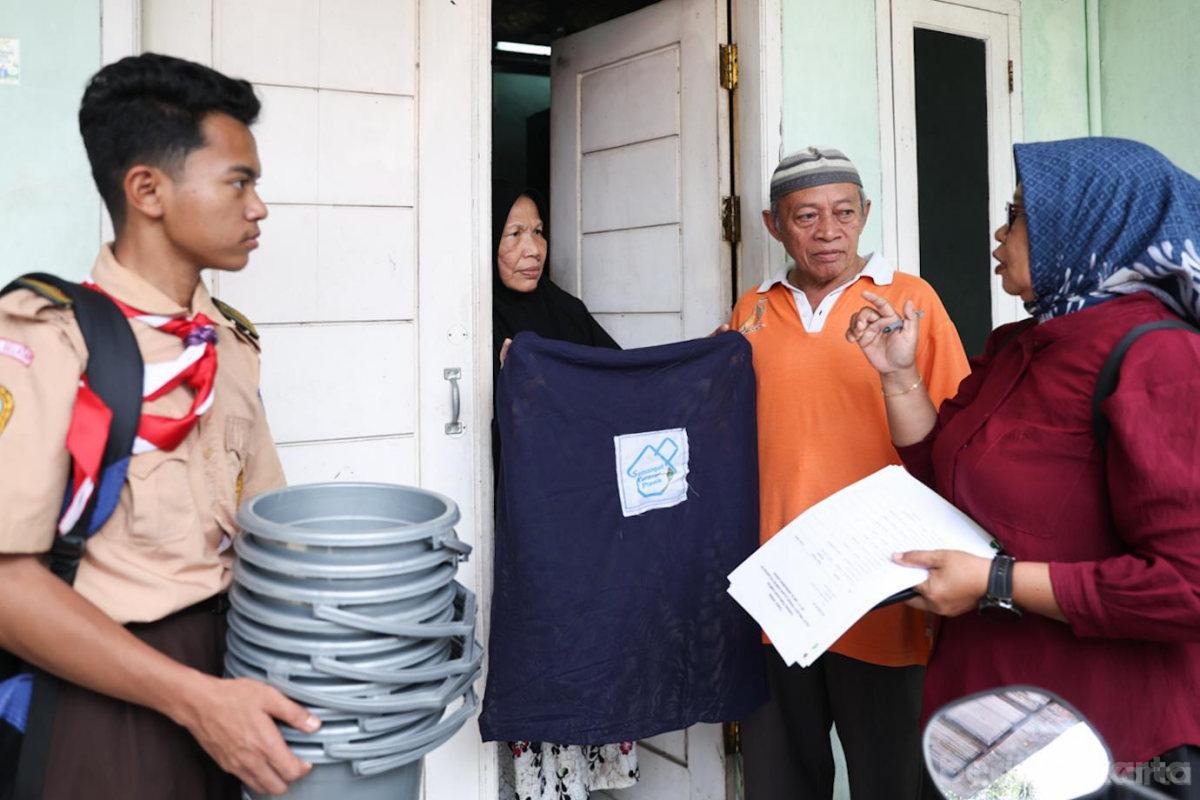
The Jakarta Provincial Government is strengthening waste management at the source by developing a system that ensures waste is not only separated at households, but also collected, transported, and processed according to type. The initiative is being implemented through a Collaborative Waste Management Pilot Project in RW 06, Srengseng Sawah, Jagakarsa, South Jakarta. More than 400 households have received door-to-door education and assistance, along with waste-sorting facilities. Head of the Jakarta Environmental Agency, Dudi Gardesi, said the policy seeks to shift Jakarta away from the traditional collect, transport, and dispose model toward waste management that begins at the source.
Dudi said waste problems cannot be addressed solely at the final processing stage, making source-level separation and processing increasingly important. The program forms part of the Large-Scale Social Collaboration for Environmental Management waste cluster, known as KSBB, and is aligned with Governor Instruction Number 5 of 2026 on waste separation and processing at the source. He stressed that household participation needs to be supported by a consistent system so that separated waste does not become mixed again during collection or transportation. The pilot project is therefore intended to create a complete chain from households to collection, transportation, and processing that can later be evaluated and expanded to other areas.
Deputy Head of the Jakarta Environmental Agency, Purwanti Suryandari, said the RW 06 program was designed to ensure waste separation does not stop at public education but is directly connected to collection and processing systems. The administration is providing special buckets for organic waste at participating homes, while separate collection schedules and drop points are being established around residential alleys. Jagakarsa was selected as a pilot location because household waste separation remains relatively low despite what officials describe as strong awareness among residents and neighborhood administrators. The system is being developed through a co-design approach involving residents, government agencies, communities, businesses, and universities so that the model reflects local conditions and can operate sustainably.
South Jakarta Assistant for Economic and Development Affairs, Iwan Santoso, said source-level waste separation is also being expanded elsewhere, with around 21,000 households in South Jakarta currently participating. The effort is supported by various organic waste processing facilities, including large biopores and modern teba systems. Through direct assistance at households, residents can learn and practice waste separation while seeing how organic waste can be processed into compost or planting media. The pilot project in Srengseng Sawah is consequently being positioned not simply as an awareness campaign, but as a practical test of an integrated waste management system from the household level through final processing.
Alexander Jason – Redaksi
