
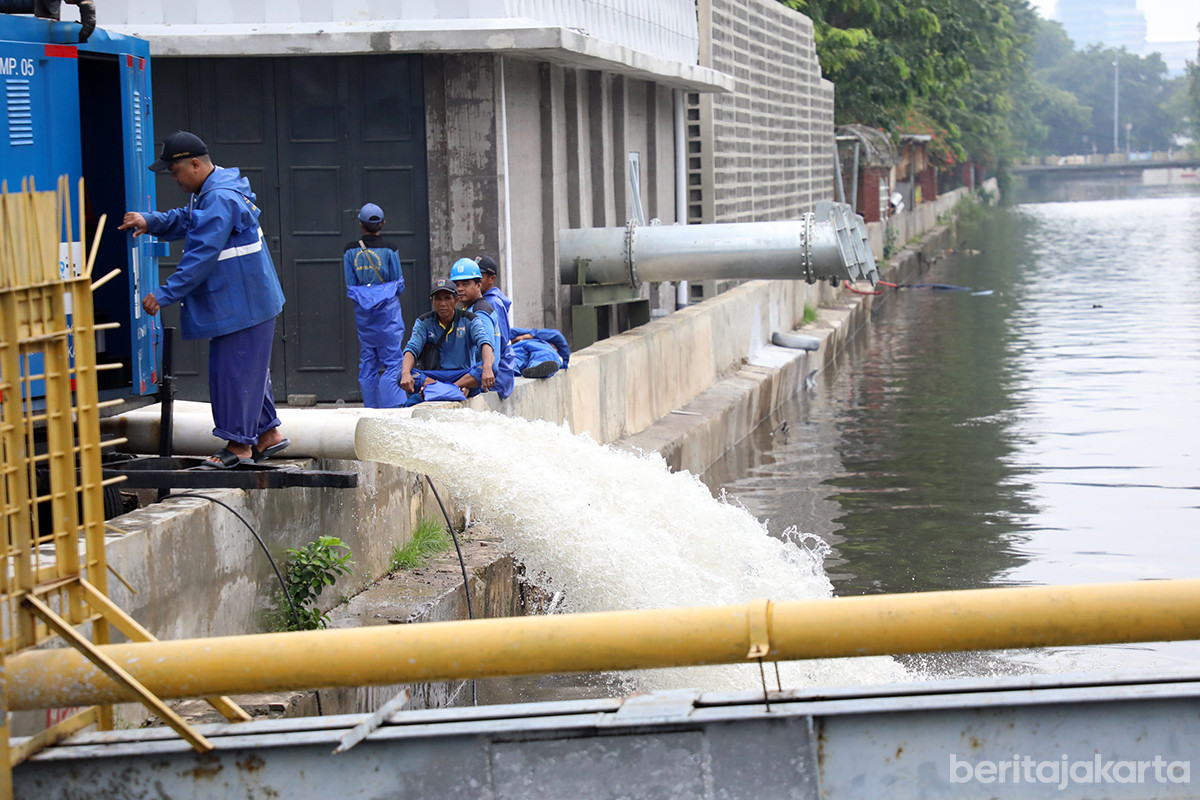
The Governor of Jakarta, Pramono Anung, stated that flood management in Jakarta cannot be handled in a fragmented or reactive manner. He argued that the core of current flood control lies in the operational readiness of pump infrastructure across vulnerable areas. The provincial government has positioned flood control as a continuous system rather than a series of isolated responses. This framing reflects a shift toward infrastructure-driven disaster governance.
The Jakarta Provincial Government has prepared 1,200 pump units to operate at full capacity during the rainy season. It has also expanded physical flood control assets such as reservoirs, including the newly inaugurated Cilangkap Batu Licin Reservoir in East Jakarta. These facilities are intended to regulate water flow and reduce surface flooding in high-risk zones. Their deployment illustrates a focus on technical preparedness rather than solely emergency response.
According to Pramono, rising water levels are now addressed immediately through active pumping, preventing the widespread pooling seen in previous years. Areas such as Ancol in North Jakarta are used as reference points to demonstrate the effectiveness of constant readiness. The government presents this operational responsiveness as evidence of improved flood mitigation performance. This approach positions infrastructure as both a preventive and corrective instrument.
Flood control in Jakarta is currently prioritized within short-term and medium-term policy horizons. Long-term solutions are acknowledged but treated as structurally complex and politically distant. The emphasis remains on interventions that can deliver visible and immediate impact. This strategy reflects a pragmatic balancing of urgency, feasibility, and administrative capacity in urban disaster management.
Alexander Jason – Redaksi
